Jump to maincontent

Workshop: Utopia, Revolution, Religion

The search for Utopia was one of several factors behind European emigration to America in the nineteeenth century. Political and social debates in European societies expanded the opportunities of emigration among religious dissenters. America, a new nation and a land of liberty and opportunity, practiced the freedom of religion and represented a society where dissenters could live their lives and establish a new Zion. With a basis in the 250th anniversary of American independence in 2026, the workshop explores how the revolutionary legacy of the United States shaped this utopian horizon.

The search for Utopia was one of several factors behind European emigration to America in the nineteeenth century. Political and social debates in European societies expanded the opportunities of emigration among religious dissenters. America, a new nation and a land of liberty and opportunity, practiced the freedom of religion and represented a society where dissenters could live their lives and establish a new Zion. With a basis in the 250th anniversary of American independence in 2026, the workshop explores how the revolutionary legacy of the United States shaped this utopian horizon.

Utsikten Amfi Norsk utvandrermuseum
Ingrid Semmingsens veg 10, 2312 Ottestad, Norway
04. – 05. Nov 2026
Registration

In nineteenth-century Europe, utopia became a powerful mode of imagining, debating, and enacting alternative worlds. Political and social debates opened up a horizon of expectation and post-revolutionary opportunity, in which America appeared as a place where history might begin anew. Religious dissenters and millenarian communities, social reformers and revolutionaries projected hopes of renewal onto America, which could appear as Zion, as a land of liberty, as a field of experiment, or as the site on which a new social order might be built from the beginning.

  • Maleri av mormonske pionerer med håndkjerre.
    1/1
    Handcart pioneers, Mormons, Iowa, 1865. Unknown
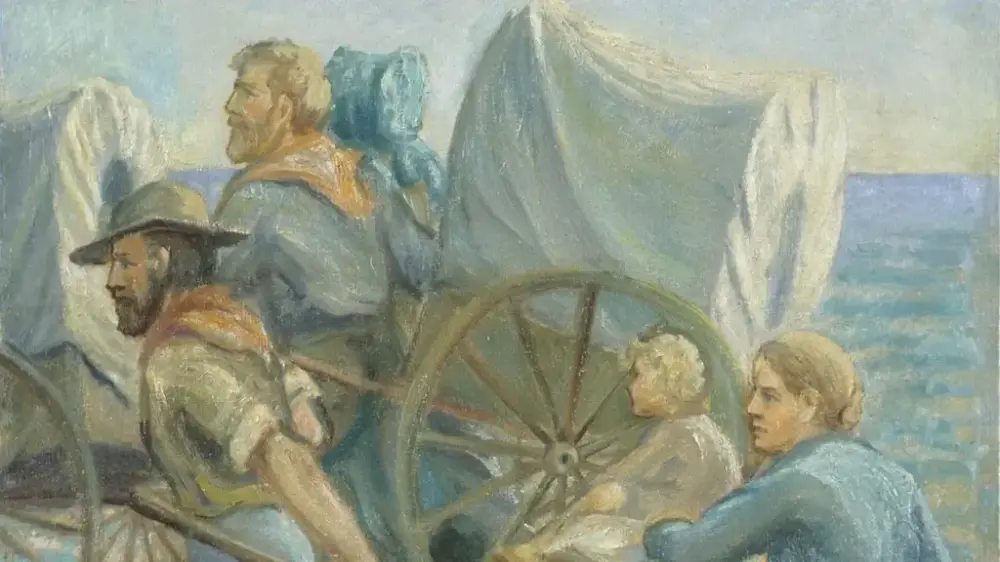
These developments have often been analyzed from the perspective of national histories, thereby obscuring their transatlantic dimensions and the longer history of ideas and movements shaped by the American Revolution and its afterlives. This workshop approaches them as entangled discourses in which religion, revolution, emigration, and social transformation were closely intertwined. Against the backdrop of the 250th anniversary of American independence, the workshop explores how post-revolutionary America became a privileged space for projecting ideas of rupture, refoundation, and collective renewal? And how did the religious history of the early republic and the American frontier—with its revivalist movements, millenarian expectations, settlement projects, Native American religions, and competing visions of sacred community—interact with these transatlantic formations of utopian thought.


12:00-12:30     Mingling, lunch 

12:30-1:15       Introduction by: Dirk Johannsen, Anja Kirsch, Terje Joranger

1:15–2:15       Adam Jortner: The Smell of Heaven: American Religion, 1800-1805

2:15-2:45        Coffee break

2:45-3:45         Tour of the museum

3:45-4:15         Coffee break

4:15-5:00        Presentation by Trym Sundby

5:00-5:15        Short break

5:15-6.00         Discussion


09:30-10:30     Presentation by Benjamin Park

10:30-11:00     Break   

11:00-12:00     Presentation by Sarah Reed      

12:00–1:00     Lunch break

1:00-2:30        Norwegian panel

2:30-3:00         Coffee break    

3:00-4:00       Foredragsholdere/ Norwegian panel

4:00-5:00       Rundebords- og avsluttende diskusjon/ Round table and final discussion